Showing posts with label Science. Show all posts

Wednesday, April 20, 2016

How Does a Homeschooler Raise a Butterfly?

I love the homeschooler changing a lightbulb joke. You know the one:

"How does a homeschooler change a lightbulb? 
First, mom checks three books on electricity out of the library, then the kids make models of light bulbs, read a biography of Thomas Edison and do a skit based on his life. 
Next, everyone studies the history of lighting methods, wrapping up with dipping their own candles. Next, everyone takes a trip to the store where they compare types of light bulbs as well as prices and figure out how much change they'll get if they buy two bulbs for $1.99 and pay with a five dollar bill.
On the way home, a discussion develops over the history of money and also Abraham Lincoln, as his picture is on the five dollar bill.
Finally, after building a homemade ladder out of branches dragged from the woods, the light bulb is installed.
And there is light."

Tuesday, April 22, 2014

Three Sisters: Day 1

This is what your back yard looks like when you neglect it for a year.
The seeds are in the ground! Well, in the dirt mound on top of the ground. I am starting to suspect that this is not going to be enough room for the Three Sisters, a pumpkin vine, and a cantaloupe vine. But if we didn't get them started when I had the energy and drive to do it, it was never going to happen. So, this Sunday, we got the seeds in. The boys have been bitten by the gardening bug, and I'm trying to let them do as much as they can on their own. My information was mostly based on what I read in a book last year, and some reading here.

From the book idea we made a raised, circular(ish) mound and planted two seeds in four parts of the circle in a square.  Once they've sprouted and are 4 inches high we'll add the beans and then the squash. My book did not say what kind of beans or squash, so I picked something labeled "Garden Bean: Kentucky Wonder" for my bean and Dark Green Zucchini for my squash. I've heard that zucchini is easy to grow, so here's hoping.

I'd also heard that pumpkin is easy to grow, so we planted two seeds in another dirt mound. We also planted a spot with two cantaloupe seeds. (Two seeds in case one doesn't sprout. If they both sprout we'll trim the smaller sprout.)

I probably should have done a better job getting rid of more of the grass in our selected area. I foresee a lot of weeding in our future. But I was nervous about waiting any longer. Of course, no I'm worried that I planted too soon in the year! This is NOT my comfort zone. But I know it's going to be a great learning experience for they kids.

Oh, yeah, and I also planted some already-started cilantro. Because.....I love cilantro.


Friday, September 13, 2013

Pill Bug Observations


Shieldy is on the tip of the stick.

This is Shieldy, Early Bird's roly poly pet for an hour. His name is "Shield-y" because he has an armored body. Early Bird came up with the name. He was actually trying to "hug" Shieldy by holding him up to his cheek, so I decided maybe we should make Shieldy a habitat that Early Bird could hold. This made him very observable, so we decided to do an impromptu nature lesson. (I love homeschooling!)


We made observations, named the category of the creature, used tools, and recorded information, just like we learned last summer when we went through Learning to Be a Scientist. After making observations and talking about pill bugs I had Early Bird draw a picture of Shieldy. We had a difficult time counting his legs, so we got the Pill Bug/Roly Poly card from the Insects and small critters full color flash cards that I found last year at Target in the $1 aisle. We learned that pill bugs are isopods, have 7 pairs of legs, 2 pairs of antennae, and have gills! We read about their habitat and diet and we tried to replicate the ideal home for Shieldy in the glass jar. This was a good time to review with Early Bird that animals need food, water, and air to live.


"This is a good home for Shieldy."
Then, once we had learned what we could, we released Shieldy back into "the wild" aka our backyard. We used the information we had learned to try to put him back where he would be most happy.

For more fun there is a Roly Poly game on PBSKids.org in the Sid the Science Kid area.

Sunday, June 30, 2013

Builder Boy and Mama's Snap Circuit Adventure, Part 2


Hey, remember how in December I was going to blog about teaching electricity to a 1st grader and using Snap Circuits? Yeah, I didn't remember either. Because around Christmas time is when the "morning" sickness hit full force and I was hovering over a bowl for the entire month... and the month after that....and then we moved to another state....I was on virtual bed rest for two months...and the Snap Circuits didn't get unpacked. But today another homeschooling mom was asking about teaching electricity and using Snap Circuits with her young son and I remembered that I had a list of resources I could share and if I'd had it in a blog post instead of random links all over the place it would have been easier. So I'm posting it now, even though it's been a while since we actually did anything with it.

Back in December I found this wonderful book Switch On, Switch Off at our local library. It explained electricity in a simple enough way that my 6 year old could understand, yet had things in it that I had never learned before. It was a great introduction to the subject and Builder Boy liked it so much that we read it together many times before returning it. I highly recommend it.

Once we'd been introduced to the topic we tried out some sites that I can't remember how I found. Here are the links:

http://www.topmarks.co.uk/Interactive.aspx?cat=66

http://www.eon-uk.com/EnergyExperience/85.htm

http://www.switchedonkids.org.uk/

http://www.ngfl-cymru.org.uk/vtc/using_electricity/eng/Introduction/default.htm


These are all games that teach about electricity in the home, where it comes from, and electricity safety. The top three are UK sites, so there is some British terminology that might need to be explained to your kids.

Since we've moved the boys have also watched a great Magic School Bus episode on electrical circuits and a Bill Nye episode on electricity. The Magic School Bus episode is "Get Charged." The one we watched on youtube disappeared, but I found another channel hosting it. The Magic School Bus episode "Gets Energized" is a great one to watch afterwards. It explores sources of energy generation, like gravity and water wheels.

I haven't read The Magic School Bus And The Electric Field Trip, but after looking at the preview on Amazon, I really want to now.

For some more ideas, check out: How to Teach Young Children About the Simple Electrical Circuit at eHow.com. I also started a Pinterest board on Electricity, but I don't have many pins yet.

_________________________________________________________________________
I don't get paid for reviews; I do get a small percentage if you purchase something on Amazon.com after clicking on one of my links.

Monday, June 10, 2013

The baby is NOT in my stomach....

So, my kids are only 6 and 4 years old. As we don't live on a farm, they haven't had the "birds and bees" talk yet. There's been some expansion of their education of the female body since I've become pregnant, but I've kept it rather vague. I've been very clear that the baby is not in my stomach, but in my womb, a "special place that only mommies have." Builder Boy hasn't asked how the baby got in my "special place;" we've read to them God Gave Us You and I'm thinking he thinks that God put the baby there; and right now, I'm okay with that. (Yes, I am running away from the inevitable conversation we're going to have to have....)

Early Bird, on the other hand, has his own conclusions. A month or so ago he was talking to me about "Squishy" when I was resting and we were talking about her growing and getting bigger. He told me he thought she got into me through my mouth and down my esophogus and into my stomach (he knows about the digestive system thanks to Magic School Bus.) I told him no, that's not how she got inside me and he said "then where's the beginning?"

I admit it: I panicked. I probably looked like a deer caught in the headlights. I was NOT prepared to explain to my 4 year old the "beginning." I ummed, and hawed, and gave a general "down there" with a wave. Not satisfied with that he examined my exposed tummy and asked if she got in through my belly button. I realized he was NOT going to let this drop, so I told him she got into me down in my underwear area. I forget his exact, very funny words, but the gist was he thought that was a weird answer and I don't think he really believed me, because since then he's said repeatedly that when she was big enough I am going to burp her out of my mouth.

It probably doesn't help that when I was going through my crazy cravings I was saying things like "the baby doesn't like ______" or "the baby really wants ______."

I searched online for some sort of picture that showed the stomach and the uterus in the same picture, but all the pictures I found were either of the digestive system or the reproductive system, not both. I asked around and someone wonderful was able to direct me to a short clip that illustrates the uterus with the baby expanding and pushing aside the other internal organs including the stomach! (THANK YOU Museum of Science and Industry!) It even shows how food goes from the mother's mouth through her system and into the placenta-umbilical cord-baby. I showed it to the boys tonight and I think Early Bird finally believes me.

Since Early Bird was focused on how the baby was going to come out (which I am much more comfortable talking about than how she got in) I explained briefly how most babies came out, but I also told them about how there were complications with their births (I have mentioned that to them before) and that the doctor had to cut them out. I showed them my incision scar and after thinking about it for a minute, Builder Boy declared that they came out "the shortcut way!"


Oh, and here's a picture of Squishy from the ultrasound two months ago. :)

Wednesday, May 22, 2013

Exploring Space: Builder Boy's Discovery, the Wall, and the Logbook

Tuesday, the day after our late night sky gazing, I was really tired. A loud something or other woke me up at 5:30 in the morning and I had trouble getting back to sleep. I wasn't feeling so good pregnancy-wise, either, so when the late afternoon came and we still hadn't started Space School, I decided I needed the day off. That didn't stop Builder Boy, however, from learning.

Early in the afternoon he started making "books;" drawing pictures of space objects and labeling them with some spelling help from me.  Then he made a book about stars and drew different diagrams of the sun and the Earth, showing the orbit, what sunrise and sunset looks like from Earth, etc. His last picture was of the sun's job in the water cycle. He talked to me about it and made the point that without the sun there would be no evaporation, no redistribution of water through clouds, and eventually all the water would be accumulate in the oceans and that would be that. I was really proud of him for thinking of that, which applied to what we were talking about on Day 4.


Today I continued to feel run down, so we just reviewed what we already knew and took down all the papers we had put up on The Learning Wall. We had filled up The Wall and we are only half way though Exploring Space. The Evan Moor Scienceworks for Kids books are set up to turn the workbook pages into a logbook, so that's what we did today. The "_________'s Space Logbook" pages I pasted on the front and back of a three prong folder ("duotangs," to my Canadian friends.) Most of the pages we did actually turn into mini books, so those went in the folder pockets. I want the space books Builder Boy made on his own with these as well, so those went in the back pocket. We will fill our Learning Wall with the rest of the pages before putting them in our book. There's just something more satisfying seeing it fill up The Wall than just adding pages to the logbook, a few at a time. We're leaving the solar system picture, the verse, song, and Builder Boy's extra drawing on The Wall.


I feel a little said about something I found out today. A few weeks back Builder Boy discovered a chart in the back of the, unfortunately outdated, Magic School Bus Lost in the Solar System book. In the chart it had the current (at the time of printing) number of moons per planet, and Builder Boy all on his own memorized the number for each planet. Well, I looked it up today, and there have been many more moons discovered since that book was printed. And there are varying reports on how many each have, as some still need to be verified. Right now Builder Boy thinks that Saturn has more moons than Jupiter, with Jupiter having 16 and Saturn having 17. But my Googling says that they both have over 60, and Jupiter has a few more than Saturn. Unfortunately, I can't seem to find a source that will give enough specifics to make a new chart for him. This feels like "Pluto isn't a planet anymore" all over again.

I've got an afternoon doctor's appointment tomorrow and out of town visitors in the evening, so I hope I can get my pregnant butt in gear and move on soon to our next concept.

Monday, May 20, 2013

Exploring Space: Day 5 (Stargazing Activity)

Well, we have learned something we did not expect to learn. Spring time is ether a really great time or a really horrible time to stargaze with kids. It's a HORRIBLE time because enough stars don't "come out" until long after bedtime. But if you're doing this in the summer time, staying up late may not be a big problem. Thanks to springtime weather, our skies are relatively clear, which is much less likely in the winter time.

Thankfully there was not too much light pollution in our back yard, so we were able to see stars without going anywhere. It took a little while for our eyes to adjust, and for it to get a little bit darker, but we DID see the Big Dipper. And we were able to use it to find what we think was the North Star, though I was expecting the North Star to be brighter than that?

Principal Daddy downloaded Google Sky Map for his Android smart phone (get the app free here) and that was helpful and fun to use. (It really wasn't dark enough to distinguish any other constellations, and it was almost 11:00 pm!) Builder Boy was very excited that it identified where the planets were in relation to him, and Early Bird had a lot of fun pointing out North, East, South, and West. 

Also, I would like to point out that the Alaskan State Flag has the Big Dipper and the North Star on it.

Good night!

Exploring Space: Day 5

Groups of stars seen together are called constellations.

Today's lesson went a bit differently from the book's plan. I do not have any books specifically on constellations or the history of naming constellations. Evan Moor's Exploring Space had worksheets/printables that required that background information, especially about the Big Dipper. So I thought a bit, Googled a bit, and came up with what we did today.

I started with reviewing Psalm 148:3 and the song we learned on Day 4. Builder Boy really loved learning about the layers of the Earth, so I showed him a picture of the layers of a star that I found in a Children's Encyclopedia. I'm not expecting him to memorize the layers like he did the layers of the Earth, but it was "cool" to him, and it also showed sun spots and flares/a prominence.

Then I re-read the two page section in Seeing Stars about constellations. We talked a bit about who named them and why. We used the Exploring Space pages on six constellations and matched the picture to the star configuration, after first just showing them the stars and having them guess why they looked like their name. Builder Boy was very good at picking out the patterns.

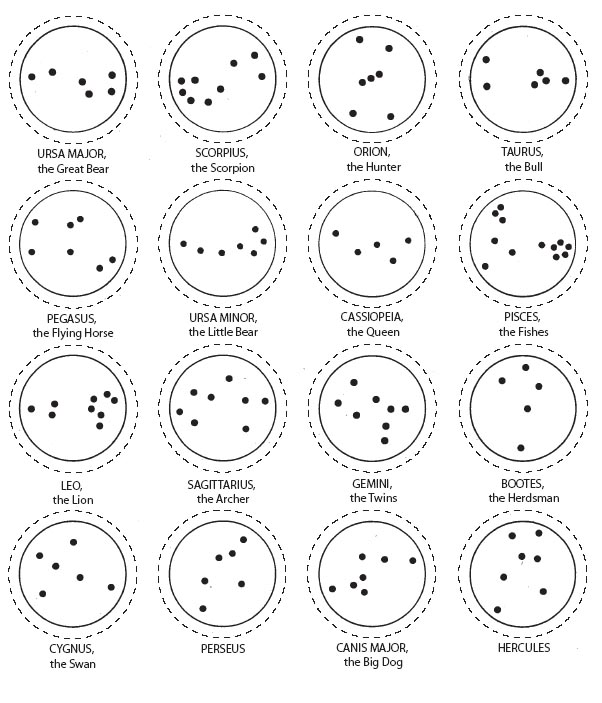
Then we moved on to some pages I found online. First I gave some connect the dots constellations to the boys for them to do. I gave Early Bird some basic shape dot-to-dots that I found at the Flutterbud Club (never heard of it before, I ran across it in the Google image search.) Builder Boy got the Connect the Constellations from SuperColoring.com. Then I gave them each a copy of Make Your Own Constellation found at the blog Early Childhood Science Activities. It has a field of stars and lets kids connect them however they want and encourages them to come up with names and even stories for their constellations. Early Bird connected every single star and named it "Giddy, the Giant Dog." Builder Boy made "The Cup" and "The Chair." The picture link on the site is broken, so I am including the image I saved from Google images, but the quality is poor and unreadable when printed at full page size. We finished off with a worksheet I found at Preschool Printables that has kids try to copy some star configurations from an example. They also have cool Constellation Discovery Map and Certificate that I didn't notice until after we were done for the day, and probably makes a better replacement for the Make Your Own Constellation page that we used, if you have a color printer.

Being in the play room with the kids books reminded me of a story in The Children's Book of Virtues, The Legend of the Dipper. I had to keep telling Builder Boy that this was a pretend story, as he kept getting hung up on the dipper changing materials throughout the story. But at least it was an example of the old stories people made up about constellations.

Once we were done with that we went back to the book and made their Star Box with an old tissue box. I made the piece of paper for the constellations a bit too big, and the holes were kind of wonky, so it wasn't exactly a planetarium show. But the kids didn't seem to notice that it wasn't perfect. Builder Boy wanted to make one of the constellations, and he chose Orion, which I thought would be do hard for him, but he actually did a really good and accurate job! He used a white crayon on black construction paper and I popped the holes for him. My camera wouldn't pick up the lights on the wall, so I took a picture of the card on the star projector.


Tonight we'll do the last activity and go outside and see if we can find the Big Dipper. Thankfully the book provides examples of how it can look at different seasons, since apparently it turns around and over throughout the year (I learned something, too!)

Yesterday while unpacking a random box we found our wall stickers that the boys love so much. Yesterday Builder Boy put up the Outer Space Peel & Stick Wall Decals above his bunk bed. Probably not tonight, but tomorrow we will put up the Celestial Glow in the Dark Peel & Stick Wall Decals that we got for his birthday. (I posted about them with pictures previously here and here.) Now that we've learned about constellations we'll probably be more inventive with putting them up. And as before, we'll use the constellation chart to put some authentic ones up.

_______________________________________________________________________________
Here are some cool things to do with constellations that I found on Pinterest, but didn't end up doing.


Saturday, May 18, 2013

Exploring Space: Day 4


I started this day with some of the preschool activities from the Astronaut Preschool Printable Pack found at HomeschoolCreations.com. There are a lot of neat things available for free, and it's wonderful that the information is out there and I don't have to reinvent the wheel. The printable pages are in color, and we only have a black and white printer, so I only printed the things that I thought would work. Early Bird loved the rocket ships to put in size order. He said "blast off" for each one, with a tiny, high pitched voice for the smaller ones and a low, gravely voice for the biggest ones. There was also a picture and shadow match game that I initially thought would be easier not being in color, but because there was a lot of silver or light gray was actually harder. But with some help, he did okay. I did these activities just with Early Bird.

The printable pack also came with the words for the Psalm 148:3 "Praise Him, sun and moon, praise Him all you shining stars." We put that up on the wall and we will work on memorizing it. There is also a song to sing to the tune of "Itsy Bitsy Spider" that the kids love and sang over and over.

Then we started on the next concept of Evan Moor's Exploring Space:

Our sun is a star.

This is something we've been talking about since the beginning, so it wasn't a new concept, but I'm committed to going through the whole book to make sure we don't miss anything new, and to cement information we've talked about. I had fun asking the kids the questions from the book and hearing their answers to:
  • If our sun is a star, why can we see it during the day?
  • Is our sun the largest star in the galaxy?
  • Could people live on the sun?
  • Why shouldn't we look at the sun?

Then we talked about why we need the sun, and wrote down three reasons on the provided worksheet. As a thought experiment I asked the boys what they thought would happen to the Earth if there was no sun exerting gravity on it. Builder Boy decided that the Earth and planets would stop moving because there would be nothing to orbit.

Next we read and colored the "Our Sun" mini book, which among other things had kids look at a picture and circle things that need light from the sun (plants, people, animals.) Early Bird's second guess was the house in the picture, so we had a good discussion about living vs. non-living things and how non-living things don't need light from the sun.

Then we went to the bathroom with a flashlight, small paper globe (I couldn't find our inflatable globe) and a plastic tomato to demonstrate eclipses. I also used this opportunity to show that not all the sun's light and heat are taken up by the earth. The tomato wasn't exactly the right scale for our size Earth, but it showed what it needed to.

Then Principal Daddy held the kids in his lap and watched two YouTube clips he found on eclipses,
What is a Lunar Eclipse? and a Solar Eclipse Educational Video. The "What is a Lunar Eclipse?" video was fairly kid friendly, but the "Solar Eclipse Educational Video" had no sound so Principal Daddy read what it said on the screen and narrated/interpreted where necessary. He did a really wonderful job at that.

As before, we finished up with playing TO THE MOON. I was able to add some of the question cards we'd left out before, since we're LEARNING!


Thursday, May 16, 2013

Exploring Space: Day 2 and 3


Earth is part of a solar system in the Milky Way galaxy.


Finishing up the first concept in Evan Moor's Exploring Space took longer than I thought it would because Early Bird out of the blue decided he needed to nap at the time I had set aside for school on Tuesday. So wrote down our space address with Builder Boy (where we are in the known universe down to our house) and re-read Seeing Stars: The Night Sky (Bright Sparks) (which was actually on the recommended list of Exploring Space) to give the information for the next concept:


Stars are huge balls of hot, glowing gases.

The two things took about 30 minutes and Builder Boy was feeling very sleepy (we did this in the afternoon) so we stopped there and picked up where we left off on Thursday.


On Thursday we colored the pictures of the planets to put them in order on black paper. I used three pieces of paper instead of 2, as they needed more space (pun intended.) I also added a sun because we needed a "starting point." Builder Boy insisted on drawing some asteroids for me to cut out for an asteroid belt. He was not impressed when the "Our Solar System" mini-book from Day 1 did not include an asteroid belt in one of their solar system pictures, and drew one in for that book, too.


When we were done putting the solar system up, we shifted to focusing on stars. We went into a windowless bathroom and lit a candle. I expanded the conversation from just "we get light and heat from stars" to demonstrating how distance from the source effects how much light and heat the planets receive. We also reviewed red dwarfs and blue giants, the fact that there is only one star in our solar system. That turned into a discussion with Builder Boy on what you need to make a solar system, and we also reviewed the name of our star; Sol. I wrote out the word "solar" to explain that the name of the sun is in the word, and he remembered the terms "solar power" and "solar energy."

Then we continued to talk about stars and galaxies as we colored in the "Stars" mini-book. I was NOT impressed with the match up options on star facts. They were NOT very clear, and the first parts of the sentences were so similar that multiple ends would work for each. Also, Builder Boy could not guess why our galaxy is called the "Milky Way." I eventually told him people named it that because it looked like milk drops. Builder Boy didn't think that was applicable because "milk gives our bodies energy and galaxies don't."
We finished up with another game of TO THE MOON and I let Early Bird use the solar system display we put on the wall to help him figure out some of the answers.

Monday, May 13, 2013

Exploring Space: Day 1


Earth is part of a solar system in the Milky Way galaxy. 

On our first day of working though Exploring Space I wanted to be prepared to offer the whole of activities for the first concept, but I knew that there was quite a bit of coloring and writing and for boys who haven't done formal schoolwork for a while. They did pretty good, but I didn't push finishing the concept. The workbook starts with taking the kids outside and having kids identify things they see in the sky and thinking about what they see in the sky at night. (Things like clouds, airplanes, the sun, etc.) Once you have a list you're supposed to go over it and cross off things that "are part of the Earth." I changed that and we separated the list into two categories: Things in our Atmosphere and Things in Space. I used a small globe and talked about the basics of the atmosphere before we went over the list and categorized each item. Later, when Early Bird was taking a nap, Builder Boy and I watched the Bill Nye episode about Atmosphere on YouTube.

Thanks to the books we've already read, the "Gather More Information" section "Objects in Space" page I showed them was all review, and Builder Boy and Early Bird got to show that they could read the big words. Next was a "What Is It?" worksheet that had pictures and a box of words that the kids needed to match up. I took Early Bird to one corner of the room to do it with him and had Builder Boy attempt it on his own. They both did well (this was review for them) and I made sure we defined the terms more specifically and had Builder Boy tell me what comets and asteroids are made up of.


We finished up with coloring and writing in the "Our Solar System" mini books and the Logbook page. That might not sound like much , but by the end of it the kids were done with anything that had to do with coloring or writing (remember, we haven't done much of this lately. That's one reason for doing this: getting us back in the swing of more formal learning.) There really isn't that much writing; the difference between this book which is for grades 1-3 and the other books that we did that were for K-1 is the space for writing what they want to you write. They're expecting older kids to be able to write in smaller spaces, and Builder Boy isn't quite there yet.

So I put off writing our address in the galaxy and coloring planets to put in order on the wall for tomorrow. We should have no problem doing that and then moving on to the next concept.

We've decided that the "wall" against the stairs is the perfect "Learning Wall" so we're putting what we do up there before we put it together as a logbook. I didn't realize it until the pages were up, but this house didn't feel like home until I saw my kids' schoolwork up there.

We finished the day's "work" with our first playing of the TO THE MOON game I got from SuperTeacherWorsheets.com. Before we started playing when I was cutting out the trivia cards I sorted out the cards with questions that my kids hadn't learned the answers to yet. I'll add them back in, plus more of my own, as we go along. I plan to play with game with them at the end of each day's lesson.

I forgot to look at a clock, so I have no idea how long all of this took. (And we took extra time outside, too, going on tangents as Builder Boy talked about photosysthsis and air, weather, compass directions, and other outdoor nature related things.)

 
Related Posts Plugin for WordPress, Blogger...