Showing posts with label Learning to Be a Scientist. Show all posts

Tuesday, August 7, 2012

Learning to Be a Scientist: Final Review

I am really glad I did this book with George, Builder Boy, and Early Bird. We didn't finish every activity, but the kids had a lot of fun and learned some things in the process. My original intent for doing this before we officially started 1st grade was to give Builder Boy an introduction to doing science school work and to get him thinking like a scientist. It definitely achieved those goals. It had enough repetition that the kids retained the concepts, but not to much that it got boring. It had enough hands-on activities that Builder Boy (a kinetic learner) retained a lot of what he learned. And there was enough practical application that Builder Boy was able to apply the concepts to his every day activities.

Knowing those concepts is also going to help with the other Evan-Moor ScienceWorks for Kids books that we will be using this year. Looking trough the Learning About Animals and Learning about My Body books I see observations and comparisons being made, sorting being done, and information being recorded in different ways.

I made a poster of the concepts so when we do science lessons we will figure out how we are being scientists with that activity. We will also continue using the lab coats when we do science.

We only did one of the last concept's activities. The first skipped activity from the "Scientists conduct investigations" is "Will a Magnet Work Through Other Materials?" which is a really cool investigation building on the information they learned earlier about magnets. We may do this investigation on the weekend for fun.

The other skipped activity is "How is Sound Made?" Given they boy's ability to make noise and to expand upon a lesson's idea loudly, I am not sad I skipped this even. They watched a Sid the Science Kid video a little while ago on sound and Builder Boy has been drawing sound waves in his pictures from time to time. I may come back to this and do it sometime, but we had to move on to Learning about Animals, and these activities just didn't get done.

Wednesday, August 1, 2012

Learning to Be a Scientist: Week 7, Day 1

Continuing Learning to Be a Scientist: the seventh (and last) concept is "Scientists conduct investigations;" the first activity is "Do Oil and Water Mix?" (This is actually the second activity in the book, but we did this one first.)


Watching oil and water separate just never gets old for me. Today I got to share that with the kids. We dyed the water blue with food coloring. The vegetable oil we used had a yellow tint, so the kids predicted that the water and oil would mix and turn green. We added the oil, mixed it up, and watched the fun. The oil looked a little greenish just because of the reflection. When it didn't turn green, George suggested that maybe we needed more oil. We added more oil and it still didn't mix. The kids were a little disappointed they guessed wrong, but I assured them that if we were never wrong we wouldn't learn anything new.

The kids then colored what happened on the worksheet, recording the information so they could explain it to their dads later.

Learning to Be a Scientist: Week 6, Day 5 (skipped)

Learning to Be a Scientist: the sixth concept is "Scientists record information and explain it to others;" the fifth activity is "Making a Graph."

This is actually the third activity, but I never got around to getting the seeds. The idea is to give the kids a mix of different seeds and have them sort them and glue them to a graph. It sounded like something the kids would have a lot of fun with, but with everything going on lately, it got forgoten about. Builder Boy had done graphs before, and will make more in math this year, so I'm not going to worry about him missing this activity.

Thursday, July 26, 2012

Learning to Be a Scientist: Week 6, Day 4

Continuing Learning to Be a Scientist : the sixth concept is "Scientists record information and explain it to others," the fourth activity is "Making a Diagram." (This is actually the seventh week doing this, but as it is the same concept as last week I am labling it as week 6. This is also the fith, not fourth activity, but I still don't have the seeds for the chart, so this is the fourth activity done.)

We started this day's lesson with review of all the things we recorded last week since it had been a while. Every lesson we have started by reviewing all the previous concepts and they are pretty good at remembering most of them. Even Early Bird can chips in with "Scientists make observations!"


This lesson had us making two diagrams: one of an apple and one of our hands. The apple diagram was a worksheet that came with the book, the hands we traced our own onto paper. This made me realized that I had never taught Builder Boy that one of his fingers is called a thumb. Oops.


I had a whole bunch of apple activities planned for when we did this activity.....a few weeks ago. But it's been a tiring week and so all we did was make the diagrams. For the apple diagram I used Apple Fractions. That book is awesome. We read it (not for the first time) after the diagrams were done. Builder Boy loves that book. It's a wonderful introduction to fractions and it teaches a LOT about apples in the process.

And that was it for the day.

Friday, July 20, 2012

Learning to Be a Scientist: Week 6, Day 3

Continuing Learning to Be a Scientist: the sixth concept is "Scientists record information and explain it to others," the third activity is "Making a Chart." (This is the fourth activity in the book, but I forgot to get the seeds for the third activity, so we'll do that next week.)

We started the lesson talking about why we record information. George figured it quickly, which was cool. We reviewed the information that we recorded on the list, and then we got out the ant models and we reviewed the information that they were suppose to convey with them. 

Then I got out the chart for today's lesson and had George and Builder Boy look at it. Builder Boy did a great job interpreting the pictures showing the life cycle of a bird. Then we talked about plant cycles and they each put together the worksheet pictures into the proper sequence. Early Bird joined us for that part; and while he did not do the sequencing very well, he did read the information with the pictures well.


This week's concept has five activities so I will be spreading it out over two weeks. Next week the kids will be making charts of their growing bean plants to share with other people.

Thursday, July 19, 2012

Learning to Be a Scientist: Week 6, Day 2

Continuing Learning to Be a Scientist : the sixth concept is "Scientists record information and explain it to others," the second activity is "Making a Model."

Today George and Builder Boy made models of ants out of dollar store play-dough (I figured it would dry hard and be cheaper than buying clay just for this.) They looked at pictures in Kingfisher First Encyclopedia of Animals as well as a toy ant to get an idea of what to make.


Builder Boy's Ant
George's Ant
My Ant
They learned that an ant had a body made out of three parts and that they have six legs. When they were done they got to play with the dough with Early Bird and George's Little Sister.

All through this section they will be sharing the information they learned with a parent to practice the "explain it to others" part of the concept as well as practicing making oral reports.

Tuesday, July 17, 2012

Learning to Be a Scientist: Week 6, Day 1

Continuing Learning to Be a Scientist : the sixth concept is "Scientists record information and explain it to others," the first activity is "Making a List."

Today's weather was perfect for today's activity. We went outside and used our ears to make observations and record on paper (tools) all the sounds we heard. The weather was sub-100*F (finally!) with enough of a breeze that the lab coats weren't too hot. Also because there was a good breeze we heard a lot of noises.

Finding the Source of the Sound (Wind Chimes)
Stomping on Rocks


Clanking Chains
Listening Ears


(Is this really a back-hoe?)
We heard wind chimes, rustling leaves, barking dogs, a leaf blower, cars, and a construction vehicle that Builder Boy identified as a back-hoe. We heard people talking, an air conditioner fan humming, and a truck beeping as it backed up. The kids also made noises by stamping their feet, walking on different surfaces like gravel and bark, and moved things that they found.


Then we went inside and sorted the sounds into "We Made," "Nature," and "Man-made" sounds.

After that I read to them about Jane Goodall in What Your Kindergartner Needs to Know as an example as a scientists who recorded information and shared it with others.
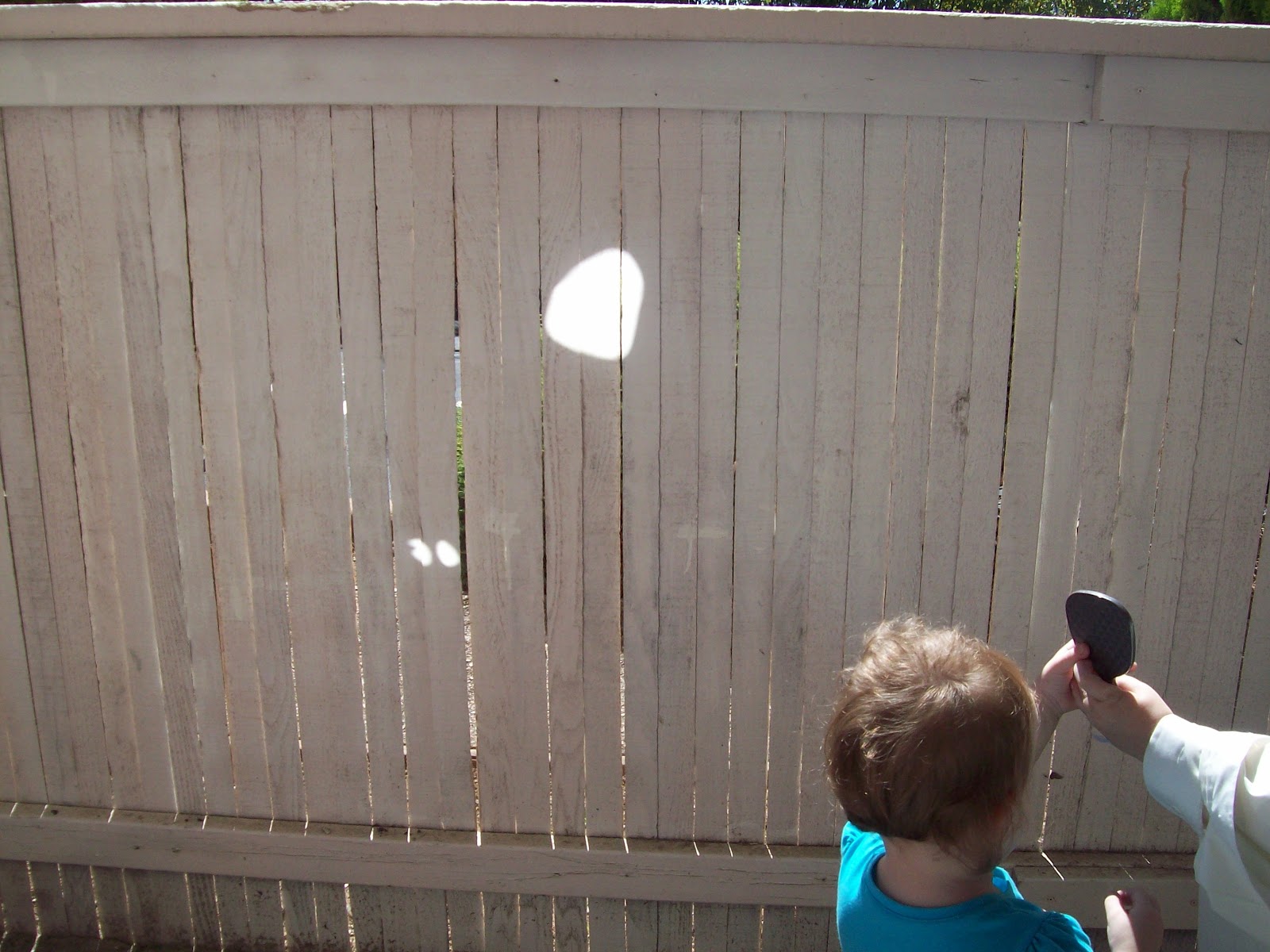
Later today I will have George explain to her mother the information we recorded and I will have Builder Boy explain to Principal Daddy.

Friday, July 13, 2012

Learning to Be a Scientist: Week 5, Day 3

Continuing Learning to Be a Scientist : the fifth concept is "Scientists use tools and equipment;" the third activity is "Reflections."


The kids had a lot of fun with this one. Builder Boy, George, and George's little sister participated. I originally planed to do this lesson in the boys' bedroom, but it has an east facing window and by the time we did the lesson in the afternoon there was no direct sunlight. Downstairs wasn't going to work, but the light and shadows were just right for doing it in the back patio. We started with using mirrors to reflect sunlight to different places. The kids had a lot of fun with that and the played for about 10 minutes before they were ready to move on. We made the reflected lights dance around; we tried to get our lights to touch and we "tagged" each other with our reflections. Builder Boy got out the old baby mirror and "bent" the light by bending the flexible mirror. It looked really cool!


Then we bounced balls against the wall to demonstration the light bouncing off the mirror.


Then we reflected the light through a light "Diffraction Grating" that came with the science kit that I got at the thrift store with the thermometer.


I made sure that they understood that the mirror was not the source of the light, it was merely reflecting it. Then we went into the under-stairs bathroom and we played with reflecting light from a flashlight. After that the kids drew the light reflecting off the mirror on the worksheet page. The kids identified the mirrors, flashlights, and balls as "tools" for learning about light.

When they were done I let them play the Sid the Science Kid I Want to Be a Scientists Game which teaches kids about the different kinds of scientists and the different tools they use.
_____________________________________________________________________________

This is a baby mirror that is similar to the one we used.


Wednesday, July 11, 2012

Learning to Be a Scientist: Week 5, Day 2

Continuing Learning to Be a Scientist : the fifth concept is "Scientists use tools and equipment,"the second activity is "Take a Closer Look."

I didn't stage that!


We reviewed all of our concepts and what magnifying glasses do. Then the kids looked at leaves and feathers with just their eyes and drew pictures of them. After that they looked at the leaves and feathers through magnifying glasses and drew more detailed pictures. Then expanding on the activity I had them make observations and comparisons of the leaf and feather. We sorted them into a "natural" category, and then in a "from a plant" and "from an animal" categories. George and Builder Boy colored in the pictures of magnifying tools and they remembered from Day 1 what a telescope and microscope look at.


Smelling the feathers
Listening to the feathers
After they finished coloring I expanded the lesson further and told them about how we can use our five senses as tools to make observations. We reviewed the five senses and used them (except taste) to make more observations about the feather and leaf. We listened to, smelt, and felt the leaves and feathers. Then I gave them pieces of watermelon and we used all five senses on them, using taste last.

_______________________________________________________________________________

PBSKids.org has a Sid the Science Game that uses magnifying glasses to look at decaying food.

Monday, July 9, 2012

Learning to Be a Scientist: Week 5, Day 1

Continuing Learning to Be a Scientist: the fifth concept is "Scientists use tools and equipment," the first activity is "Choosing the Right Tool."

After reviewing the concepts they have already learned we talked about the different tools we used two weeks ago to measure weight and lengths. Then we brought out the bathroom scale and a little kitchen scale I found at the thrift store. I did not find a balance or pan scale cheap secondhand, so we had to do without. We talked about what scales weigh big things and what scales weigh little things. George's mom works in a grocery store and George recognized the picture of a kitchen scale as the ones that are used in the produce section of the store. Builder Boy and George completed the two worksheets connecting pictures of tools and what they are used for. George recognized the picture of the rotary pencil sharpener, but Builder Boy had never seen one. The water fountain picture had a turn knob instead of a push bar like they have now. In hindsight, they didn't need to do that extra worksheet, but it didn't hurt them to do it. They also colored some of the pictures for the Scientists at Work mini-book, but Builder Boy had a melt down and needed to stop. To learn about balance scales I let them play the Sid the Science Kid Pan Balance Game and the More part of Starfall.com has a Weight balance pan game under the Geometry & Measurement category.

Learning to Be a Scientist: Week 4, Day 3 (re-do)

The experiment we preformed for the Learning to Be a Scientist Week 4, Day 1 did not turn out the way it was suppose to. I thought it was because I used thin dollar store index cards, so today we tried it again with thicker index cards.


Early Bird finally wanted to wear his lab coat!


We measured the width to make it fair.

Bigger Folds
Smaller Folds

The thicker cards definitely held more weight. We folded the thicker cards two different ways. This time it was obvious why the folded card was suppose to be stronger. But the card edges kept slipping, so we were not able to make them hold more. We couldn't put the blocks any closer because then the edges of the cup would be on the blocks. Having cups with wider bottoms also contributed to holding more pebbles. But in the end we couldn't make it come out right. The kids didn't seem to mind, though. They had a lot of fun making bridges.

Thursday, June 28, 2012

Learning to Be a Scientist: Week 4, Day 3

Continuing Learning to Be a Scientist: the fourth concept is "Scientists make measurements," the third activity is "Which Is Stronger?"

(Early Bird insisted on being shirtless)
 This lesson was a bust. The idea is to test two bridges made of an index card; one flat and one folded accordion style. You are suppose to put a cup on the bridge and put in pebbles to test which is stronger. The accordion style bridge is suppose to be stronger. That is not what happened. Our flat bridge held 11 pebbles (I used decorative sea glass pebbles) and the folded bridge collapsed at 4. We tried two different sizes of index cards, we tried smaller folds and bigger folds. The folded one was weaker every time. I wonder if it is because I used thinner dollar store index cards? I am going to buy some thicker ones and have Builder Boy re-test this to see if that makes a difference. But it was disappointing to see it not work.


Builder Boy, living up to his name, started building stronger bridges with more blocks. He made one that held 25! So I just let them play making bridges.


Related Posts Plugin for WordPress, Blogger...