Showing posts with label 1st Grade. Show all posts
Monday, April 25, 2016
Logic Resources before the Logic Stage: Part 2
A continuation of what we're doing with logic before beginning formal logic in 5th grade in the fall. (Part 1 here.)
Friday, April 22, 2016
Logic Resources before the Logic Stage: Part 1
While we have been doing things differently than a strictly classical education approach in the last few years, I still like to "check in" with The Well Trained Mind to get an idea of what our goals should be close to. I started Builder Boy's 4th grade year with the goal of having him ready for the classical approach for 5th grade as laid out by TWTM. Not sure if we'll actually get there or not, but I do like the idea of introducing formal logic in 5th grade. But I didn't want to just dump it on him with no warm up, so this 4th grade year we have been having some fun with various playful logic resources to introduce him to the concepts.
Wednesday, April 20, 2016
How Does a Homeschooler Raise a Butterfly?
I love the homeschooler changing a lightbulb joke. You know the one:"How does a homeschooler change a lightbulb?
First, mom checks three books on electricity out of the library, then the kids make models of light bulbs, read a biography of Thomas Edison and do a skit based on his life.
Next, everyone studies the history of lighting methods, wrapping up with dipping their own candles. Next, everyone takes a trip to the store where they compare types of light bulbs as well as prices and figure out how much change they'll get if they buy two bulbs for $1.99 and pay with a five dollar bill.
On the way home, a discussion develops over the history of money and also Abraham Lincoln, as his picture is on the five dollar bill.
Finally, after building a homemade ladder out of branches dragged from the woods, the light bulb is installed.
And there is light."
Thursday, October 15, 2015
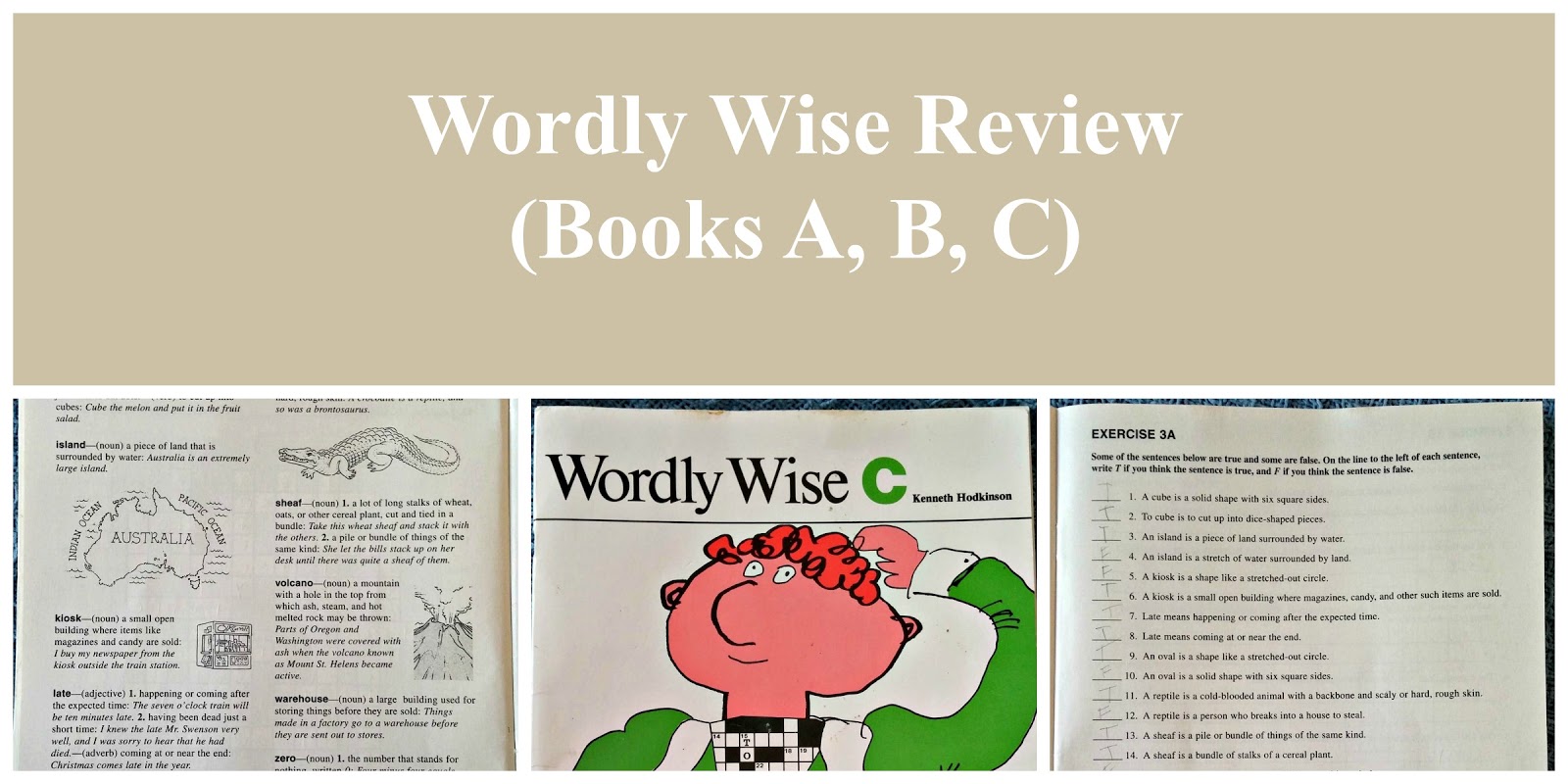
Wordly Wise A, B, and C Review
We recently completed the Wordly Wise series A, B, and C and have moved on to Wordly Wise 3000 workbooks. We first started these workbooks sometime in Builder Boy's 2nd grade year, after they took the DORA for the first time and the results showed that they were ready for a vocabulary program and would benefit from one. I asked around my online homeschooling groups and purchased the first book from Rainbow Resource online. I purchased the answer key (sold separately) as well, but it really wasn't necessary. It was pretty obvious to me what the answers were most of the time.
Friday, October 2, 2015
Catching Up in Language Arts, Part 1: FLL3 and WWE2
The goals:
- Finish First Language Lessons level 3 and 4 in one year's time and be prepared to move on to 5th grade grammar at the beginning of the next school year.
- Finish Writing With Ease level 2 by the middle of the school year and move on to a new curriculum, probably Brave Writer.
The purpose of this post: to show you how we are doing it if you ever find you want to do something similar, and a reminder that curricula is not the boss of you.
Monday, August 31, 2015
First Day of School 2015
Here we are at our fourth first day of school. I know it's cliche to say, but it really does seem like we just had our very first day of homeschool recently.
We started with our traditional pancake breakfast and pictures with signs. This year I also added a little present; a math concept book for Builder Boy and a Beethoven action figure for Early Bird. Lady Bug was not impressed with my signs or picture attempts this year.
This was our first year not taking a break before the start of the new school year. We have been working on vocabulary, spelling, handwriting, and math consistently starting at the same time every day for the past two months. I have to say I really think this works best for us. The no-longer-summer-schedule saw us add just two new subjects (grammar and writing) in the morning and I got the next Story of the World cds for them to listen to during quiet time.
If our current schedule and system works for us, then I will blog about it. But I don't want to count my chickens just yet.
We started with our traditional pancake breakfast and pictures with signs. This year I also added a little present; a math concept book for Builder Boy and a Beethoven action figure for Early Bird. Lady Bug was not impressed with my signs or picture attempts this year.
This was our first year not taking a break before the start of the new school year. We have been working on vocabulary, spelling, handwriting, and math consistently starting at the same time every day for the past two months. I have to say I really think this works best for us. The no-longer-summer-schedule saw us add just two new subjects (grammar and writing) in the morning and I got the next Story of the World cds for them to listen to during quiet time.If our current schedule and system works for us, then I will blog about it. But I don't want to count my chickens just yet.
Monday, August 19, 2013
Workbooks as Year End Testing
With our last half of our 2012-2013 being more un-schooling than anything else, I guess I shouldn't have been surprised when this weekend I told Builder Boy he was finished with 1st grade and was going to be a 2nd grader and he didn't really seem to think anything of it. At least Early Bird was excited to hear he was finally a kindergartener, though he worried about how that would effect his placement at kids' church. (We place him there by age rather than grade, so it won't change.)

Last year at the "end" of Builder Boy's kindergarten year I got a kindergarten skills workbook to see how he did in comparison to public school standards and to check for gaps and weaknesses. It actually taught him some things that I didn't think to teach him, so I was doubly glad we did it.
This weekend we got the 1st grade workbook for review for Builder Boy and I got the LeapFrog Kindergarten Skills workbook for Early Bird since he loves LeapFrog so much. We started doing some yesterday and all ready I've realized that while un-schooling worked for science, history, and reading, it did NOT work for handwriting. I think Builder Boy has forgotten the "correct" way to write at least half of the letters. And a page of just addition or subtraction problems was something he was NOT used to and felt overwhelmed by. Our chosen math curriculum has been much more hands on manipulatives and very little writing and no worksheets like that, so it was definitely a new experience for him. Early Bird did just fine on his pages, though he got tired of the color by number page and didn't finish it.
So to get into the swing of a more structured schoolwork routine before our official year begins in the fall, we will finish our current workbooks and then move into others that I have on hand. The timing all depends on when Lady Bug starts sleeping long enough for Mommy not to be completely exhausted during the day.
_____________________________________________________________________
The picture of the workbook we used last year is an Amazon affiliate link. The LeapFrog link is not.
This weekend we got the 1st grade workbook for review for Builder Boy and I got the LeapFrog Kindergarten Skills workbook for Early Bird since he loves LeapFrog so much. We started doing some yesterday and all ready I've realized that while un-schooling worked for science, history, and reading, it did NOT work for handwriting. I think Builder Boy has forgotten the "correct" way to write at least half of the letters. And a page of just addition or subtraction problems was something he was NOT used to and felt overwhelmed by. Our chosen math curriculum has been much more hands on manipulatives and very little writing and no worksheets like that, so it was definitely a new experience for him. Early Bird did just fine on his pages, though he got tired of the color by number page and didn't finish it.
So to get into the swing of a more structured schoolwork routine before our official year begins in the fall, we will finish our current workbooks and then move into others that I have on hand. The timing all depends on when Lady Bug starts sleeping long enough for Mommy not to be completely exhausted during the day.
_____________________________________________________________________
The picture of the workbook we used last year is an Amazon affiliate link. The LeapFrog link is not.
Friday, June 7, 2013
Reading Eggs Review: Starting Up and a Walk Though Lesson 88
10 days ago I signed the boys up for a free trial of ReadingEggs.com. I had heard of it mentioned before on homeschooling blogs, forums, and sites, and heard other parents mention it. I knew you had to pay for it, and since we had already paid $35 for a year's subscription to MoreStarfall.com, I wasn't looking for something else to buy. Early Bird was perfectly content with MoreStarfall, even though he wasn't learning anything new reading wise (it only goes through a 1st grade level, but it stops teaching after the basics) and I wasn't really sure how much he was getting out of the math games he played.
It's the past six months of this pregnancy a lot of schoolwork has gotten dropped; more than I'd like to admit. That has slowed the kids' reading progress down, though they keep picking things up. Then two weeks ago a friend posted a screenshot of one of her son's Reading Eggs lessons, and I was impressed because not only did it have much higher level words than I had ever seen on Starfall, but it had her kid matching the words to picture, working on understanding what the word meant and not just the ability to be able to read it. So I messaged her for a link and she had Reading Eggs send me an e-mail with a 14 day free trial (you can get the free trial on your own, but by doing it through her she got to "earn" a few more free weeks herself.) She also sent me some codes she had found around the internet that got me to 70 days free before I'm going to have to decided to pay or not. (I'll post those codes at the bottom of the post.)
I don't like starting the kids on something that I don't know if I'm going to want them to continue. What if they get super excited about it, but I'm really unhappy with it, and then it has to go away? I know disappointments are a part of life, but that's not a situation I put my kids in if I can at all help it. So I'm going to write a review (actually, I'm going to write several since there are a lot of parts to this website) that is the kind of review I would have liked to see before signing up.
I started the process with Early Bird. It was a simple sign up and did not require a credit card number to get the free trial. It offered to let Early Bird start at the beginning (which I'm assuming is learning letters and sounds) or if I wanted to I could let him take a placement test. Early Bird has never done anything like that before, but I let him try. The multiple choice test that says the question progressively got harder as he went along. At any time once you got three questions wrong the test would stop and it would place you accordingly. Early Bird made it through all 40 questions, getting only one wrong and needing me to re-phrase the question (we've never used the term "word family" before) three times. Out of 120 lessons that placed him at lesson 71. (Builder Boy took the test later, missed two, and it put him on the same lesson, so I'm assuming that's the ceiling level for the test.) There is a picture map for every ten lessons. Lesson 71 was the first lesson on Map 8. At the end of the path on each map there is a 15 question quiz that goes over what was covered in that map. You must get (I think) 11 correct to move on to the next map. Because they tested ahead on the path, all the other lessons and maps that came before 71 were unlocked, but your child has to finish a lesson before continuing on.
Each lesson is made up of several smaller parts that are interactive instructions or practice type games. Each part has to be completed with a certain level of accuracy (I really like that condition) before the next part of the lesson can be unlocked, but you can go back and play/work on anything that you have unlocked. The below is Early Bird working through Lesson 88 (the last lesson he did today.)
Part 1 of Lesson 88 introduced the "th" blend. First it had him just click on "th" as it said the sound. Then it had him select the "th" out of three blend options. Then it had him take turns clicking on Shelley Shark and then Charlie Chimp to push the two parts of the word together to make a word. It did that with several 'th-' words. When Builder Boy did this lesson a few days ago (he's going a bit faster than Early Bird, for reasons I'll mention in another Reading Eggs review) he was annoyed about how many times he had to click on both of them to make them come together. But for a new reader, I can see how that's an important step.
Part 2 of Lesson 88 is a simple matching the word to the picture game. Once they have done it correctly the words are taken back and mix them up and the kids do it two more times so they are putting the words up because they know it, not just because they guessed right. Kids are not expected to be able to read these words (I think?) When the mouse is over the word it does say it out loud for the kid.
If my kids were not already able to read these words, I would have a problem with this. I am very strict about systematic phonic instruction and have a fear of just memorizing words as "sight words. Now knowing that they introduce words this way long before the kids know the "rules" for why these words are pronounced the way they are, I would not use Reading Eggs as my main means of instruction, and I am glad I did not put my kids on Reading Eggs before they were already reading these words on their own. But I know that not all parents are as ridged about this as I am. (Jen over at Teaching My Baby to Read wrote a great blog post about it if you'd like to read more about why people think the mixed approach that Reading Eggs is using works well.)
Part 3 of Lesson 88 had Early Bird read a word and then decide which letter blend lane the word belongs in. Early Bird had a hard time with this game the first time because he clicked on the sign above the lane instead of the lane with the pins, so sometimes it went wrong; and if you get too many wrong, you have to re-do it. So, being only 4 years old, he insists he needs help on this one, even though all I do is remind him to click on the pins.
This game is an example of why I decided that even though the test didn't get the full extent of the boys' reading abilities, I'm glad it placed them where it did. When they first stated playing the Reading Egg lesson games, the instructions were a short description at the beginning, and that's it. They assume that you've gone through all the maps to get to this point and that this is not the first time you're doing them, so you should know what to do. The first day they boys played Reading Eggs I sat with them and helped them figure out what they were suppose to do. There are a lot of different practice formats and there was at least one that took me a long time to figure out what exactly they were looking for. But ten days in the kids have got it all figured out, mostly.
Part 4 of Lesson 88 did not impress me. Early Bird was given a word that I knew he could read, but Reading Eggs had no reason to think he could. They told him what it was, then had him pick it out of a group with two other words that, again, I knew he could read, but they had no reason to think he could. 16 different times with different, all complex, big words around "his" word. I'm not going to write anything more about this because I don't want to come off like a ranting psycho-mom, but there is no way this is the way I would chose to teach reading to a child.
Part 5 of Lesson 88 once again had kids working with words that they had not been taught the "rules" for. In this practice game they were given a word one at a time and were suppose to match it to the available words. It did not expect kids to be able to read them; when you hovered over a word it said it for you. That was the extent of the "teaching" in this part of the lesson.
Part 6 of Lesson 88 has an activity that I can't quiet make up my mind about. It starts with a book that they have read/had read to them at the end of a recent lesson before this. The lower maps/lessons have books with less options of words to choose from. As the kids have only heard/read this book once before, they seem to expect them to remember a lot, or else be able to infer a lot. This is one of the lessons/games that I get called over to help with the most. I had really hoped that the boys could use Reading Eggs completely on their own; maybe after another ten days they won't "need" me anymore.
Part 7 of Lesson 88 I really like. It's a gentle way to introduce dictation, which is something that the boys are going to be encountering in later levels of our planned writing curriculum, but isn't something they have done before. The words (sometimes they're owls on a fence, I've also see them as bricks in a wall) start up and in the correct order. The game slowly reads the words, highlighting each word as it's being read. It then asks the kid to read the words as it slowly highlights them. Then they scramble the words and take them down and ask the child to put the words back in the correct order. Here is where the kids really needed to pay attention because it expects you to remember the correct order. Like many of the other games/lesson in Reading Eggs, and unlike the games in Starfall, there is no repeat/say again button for the kids to press. So if they weren't paying attention, they're going to have a more difficult time. I think this has been good for the boys, and over the past ten days they have gotten better at this game. They are given several sentences, one after another, and some of the sentences are longer than the one pictured.
Part 8 of Lesson 88 tests kids' words per minute speed (actually, it's words per two minutes.) Here they only use words that have had the phonetic rules explained and practiced before. They also use a limited number of words, repeating words and changing around the picture placements as you go along. Nether of my boys had any timed reading or speed pressure put on them before, but they do very well. Sometimes Early Bird panics if he can't find the picture right away and insists he needs help, but he does fine. I like that once again they are connecting the words that they are reading to a picture of it, improving comprehension.
On a previous lesson I had noticed that they had the word "peg" and the picture they matched it to was of a wooden clothes pin. I was confused by that, but I explained that that was the picture they were looking for, and after a few reminders the kids correctly select that picture for the word "peg" from then on. On this lesson they had the word "chips" but the picture they wanted was a picture of what we in America know as "french fries." Thankfully I am a Doctor Who fan, so I had an idea of where that came from. I looked it up and apparently Reading Eggs was originally created in Australia, which explains the chips/french fries and their British accent option. This is only the second time in twenty lessons I have encountered a British/Australian/American discrepancy that had to be explained to the boys, though I don't watch every lesson.
Part 9 of Lesson 88 was the last part of the lesson. Lessons in Map 8 (where we started) tended to have shorter lesson parts, but more of them. Lessons from Map 9 and 10 seem to have fewer lesson parts, but they take longer. All lessons end with a book. You can choose to turn the audio off, or have it "read" it to you.
Along the path for each lesson is an unhatched egg. Once the child has completed the whole lesson there is a short animation of a creature hatching from the egg . When you go back to the map the creature is there instead of the egg. If you hover over it it will move a little bit, but as far as I can tell, they don't do anything else.
So that's a walk through a whole lesson at Level 3. From Reading Eggs' website:
"The Stepping Stones Reading lessons are the core of the Reading Eggs learn-to-read program. Each lesson builds on the previous one to build skills in the five key areas needed to become a good reader: phonemic awareness and phonics, sight words, vocabulary, fluency and comprehension. The lessons are presented in three broad levels with 40 lessons in each level.
Level 1 Starting Out for absolute beginners, lesson 1-40.
Level 2 Beginning to Read for emerging readers, lessons 41-80.
Level 3 Building confidence for early readers, lessons 81-120."
I have not seen any of the lessons for the Level 1, so I do not know how well it would work for a young beginner. While searching for more information for this review (after I has almost completed this post) I found the "Try Sample Lesson" option on ReadingEggs.com. It offers two lessons from Level 1 and one from Level 2.
Overall, I personally would not use this program as the only source of instruction; and I would not sign up a beginner reader who I did not want being exposed to complex words with no instruction context. For example, in a previous lesson I watched them introduce -ide words, but no explanation of the Silent E Rule. So kids would memorize the "ide" sound, but not apply that an "e" at the end of the word makes the "i" say it's name and that's why. But I can also see how this would work for other parents and kids who don't have the same learning to read philosophy as I do.
We are ten days into our free trial and I am still not sure if I am going to pay for it once our time is up. The kids love it, there's no getting around that. But they want $50 for a 6 month subscription, just for one kid! And another $25 for a second kid. That's $75 for just 6 months! There are a lot of other features that Reading Eggs offer that comes with that price that I will review in other posts (I've worked on this post long enough, I want to get this up already.) Here are the codes I used that got me the extra 7 weeks free on top of the original 2 week trial. (You can only use two codes a year.) 5ABCSHOP & ABC88EGG. (ETA: these codes are now expired.)
ETA: My friend who got us started with Reading Eggs over at We're All Mad Here wrote a Reading Eggs review, too! Since she uses it as primary instruction and the whole-words memorization works really well for her son, I thought it would be interesting for people to see another side of this.
__________________________________________________________________________
I was not asked to review Reading Eggs and was not compensated to do so. I put the time and effort into this review because I wish I could have read something like this before I started it with my kids. All opinions are my own.
It's the past six months of this pregnancy a lot of schoolwork has gotten dropped; more than I'd like to admit. That has slowed the kids' reading progress down, though they keep picking things up. Then two weeks ago a friend posted a screenshot of one of her son's Reading Eggs lessons, and I was impressed because not only did it have much higher level words than I had ever seen on Starfall, but it had her kid matching the words to picture, working on understanding what the word meant and not just the ability to be able to read it. So I messaged her for a link and she had Reading Eggs send me an e-mail with a 14 day free trial (you can get the free trial on your own, but by doing it through her she got to "earn" a few more free weeks herself.) She also sent me some codes she had found around the internet that got me to 70 days free before I'm going to have to decided to pay or not. (I'll post those codes at the bottom of the post.)
I don't like starting the kids on something that I don't know if I'm going to want them to continue. What if they get super excited about it, but I'm really unhappy with it, and then it has to go away? I know disappointments are a part of life, but that's not a situation I put my kids in if I can at all help it. So I'm going to write a review (actually, I'm going to write several since there are a lot of parts to this website) that is the kind of review I would have liked to see before signing up.
I started the process with Early Bird. It was a simple sign up and did not require a credit card number to get the free trial. It offered to let Early Bird start at the beginning (which I'm assuming is learning letters and sounds) or if I wanted to I could let him take a placement test. Early Bird has never done anything like that before, but I let him try. The multiple choice test that says the question progressively got harder as he went along. At any time once you got three questions wrong the test would stop and it would place you accordingly. Early Bird made it through all 40 questions, getting only one wrong and needing me to re-phrase the question (we've never used the term "word family" before) three times. Out of 120 lessons that placed him at lesson 71. (Builder Boy took the test later, missed two, and it put him on the same lesson, so I'm assuming that's the ceiling level for the test.) There is a picture map for every ten lessons. Lesson 71 was the first lesson on Map 8. At the end of the path on each map there is a 15 question quiz that goes over what was covered in that map. You must get (I think) 11 correct to move on to the next map. Because they tested ahead on the path, all the other lessons and maps that came before 71 were unlocked, but your child has to finish a lesson before continuing on.
Each lesson is made up of several smaller parts that are interactive instructions or practice type games. Each part has to be completed with a certain level of accuracy (I really like that condition) before the next part of the lesson can be unlocked, but you can go back and play/work on anything that you have unlocked. The below is Early Bird working through Lesson 88 (the last lesson he did today.)
![]() |
| Part 1 |
Part 1 of Lesson 88 introduced the "th" blend. First it had him just click on "th" as it said the sound. Then it had him select the "th" out of three blend options. Then it had him take turns clicking on Shelley Shark and then Charlie Chimp to push the two parts of the word together to make a word. It did that with several 'th-' words. When Builder Boy did this lesson a few days ago (he's going a bit faster than Early Bird, for reasons I'll mention in another Reading Eggs review) he was annoyed about how many times he had to click on both of them to make them come together. But for a new reader, I can see how that's an important step.
![]() |
| Part 2 |
Part 2 of Lesson 88 is a simple matching the word to the picture game. Once they have done it correctly the words are taken back and mix them up and the kids do it two more times so they are putting the words up because they know it, not just because they guessed right. Kids are not expected to be able to read these words (I think?) When the mouse is over the word it does say it out loud for the kid.
If my kids were not already able to read these words, I would have a problem with this. I am very strict about systematic phonic instruction and have a fear of just memorizing words as "sight words. Now knowing that they introduce words this way long before the kids know the "rules" for why these words are pronounced the way they are, I would not use Reading Eggs as my main means of instruction, and I am glad I did not put my kids on Reading Eggs before they were already reading these words on their own. But I know that not all parents are as ridged about this as I am. (Jen over at Teaching My Baby to Read wrote a great blog post about it if you'd like to read more about why people think the mixed approach that Reading Eggs is using works well.)
![]() |
| Part 3 |
Part 3 of Lesson 88 had Early Bird read a word and then decide which letter blend lane the word belongs in. Early Bird had a hard time with this game the first time because he clicked on the sign above the lane instead of the lane with the pins, so sometimes it went wrong; and if you get too many wrong, you have to re-do it. So, being only 4 years old, he insists he needs help on this one, even though all I do is remind him to click on the pins.
This game is an example of why I decided that even though the test didn't get the full extent of the boys' reading abilities, I'm glad it placed them where it did. When they first stated playing the Reading Egg lesson games, the instructions were a short description at the beginning, and that's it. They assume that you've gone through all the maps to get to this point and that this is not the first time you're doing them, so you should know what to do. The first day they boys played Reading Eggs I sat with them and helped them figure out what they were suppose to do. There are a lot of different practice formats and there was at least one that took me a long time to figure out what exactly they were looking for. But ten days in the kids have got it all figured out, mostly.
![]() |
| Part 4 |
Part 4 of Lesson 88 did not impress me. Early Bird was given a word that I knew he could read, but Reading Eggs had no reason to think he could. They told him what it was, then had him pick it out of a group with two other words that, again, I knew he could read, but they had no reason to think he could. 16 different times with different, all complex, big words around "his" word. I'm not going to write anything more about this because I don't want to come off like a ranting psycho-mom, but there is no way this is the way I would chose to teach reading to a child.
![]() |
| Part 5 |
Part 5 of Lesson 88 once again had kids working with words that they had not been taught the "rules" for. In this practice game they were given a word one at a time and were suppose to match it to the available words. It did not expect kids to be able to read them; when you hovered over a word it said it for you. That was the extent of the "teaching" in this part of the lesson.
![]() |
| Part 6 |
Part 6 of Lesson 88 has an activity that I can't quiet make up my mind about. It starts with a book that they have read/had read to them at the end of a recent lesson before this. The lower maps/lessons have books with less options of words to choose from. As the kids have only heard/read this book once before, they seem to expect them to remember a lot, or else be able to infer a lot. This is one of the lessons/games that I get called over to help with the most. I had really hoped that the boys could use Reading Eggs completely on their own; maybe after another ten days they won't "need" me anymore.
![]() |
| Part 7 |
Part 7 of Lesson 88 I really like. It's a gentle way to introduce dictation, which is something that the boys are going to be encountering in later levels of our planned writing curriculum, but isn't something they have done before. The words (sometimes they're owls on a fence, I've also see them as bricks in a wall) start up and in the correct order. The game slowly reads the words, highlighting each word as it's being read. It then asks the kid to read the words as it slowly highlights them. Then they scramble the words and take them down and ask the child to put the words back in the correct order. Here is where the kids really needed to pay attention because it expects you to remember the correct order. Like many of the other games/lesson in Reading Eggs, and unlike the games in Starfall, there is no repeat/say again button for the kids to press. So if they weren't paying attention, they're going to have a more difficult time. I think this has been good for the boys, and over the past ten days they have gotten better at this game. They are given several sentences, one after another, and some of the sentences are longer than the one pictured.
![]() |
| Part 8 |
On a previous lesson I had noticed that they had the word "peg" and the picture they matched it to was of a wooden clothes pin. I was confused by that, but I explained that that was the picture they were looking for, and after a few reminders the kids correctly select that picture for the word "peg" from then on. On this lesson they had the word "chips" but the picture they wanted was a picture of what we in America know as "french fries." Thankfully I am a Doctor Who fan, so I had an idea of where that came from. I looked it up and apparently Reading Eggs was originally created in Australia, which explains the chips/french fries and their British accent option. This is only the second time in twenty lessons I have encountered a British/Australian/American discrepancy that had to be explained to the boys, though I don't watch every lesson.
![]() |
| Part 9 |
Part 9 of Lesson 88 was the last part of the lesson. Lessons in Map 8 (where we started) tended to have shorter lesson parts, but more of them. Lessons from Map 9 and 10 seem to have fewer lesson parts, but they take longer. All lessons end with a book. You can choose to turn the audio off, or have it "read" it to you.
![]() |
| Egg Hatching |
So that's a walk through a whole lesson at Level 3. From Reading Eggs' website:
"The Stepping Stones Reading lessons are the core of the Reading Eggs learn-to-read program. Each lesson builds on the previous one to build skills in the five key areas needed to become a good reader: phonemic awareness and phonics, sight words, vocabulary, fluency and comprehension. The lessons are presented in three broad levels with 40 lessons in each level.
Level 1 Starting Out for absolute beginners, lesson 1-40.
Level 2 Beginning to Read for emerging readers, lessons 41-80.
Level 3 Building confidence for early readers, lessons 81-120."
I have not seen any of the lessons for the Level 1, so I do not know how well it would work for a young beginner. While searching for more information for this review (after I has almost completed this post) I found the "Try Sample Lesson" option on ReadingEggs.com. It offers two lessons from Level 1 and one from Level 2.
Overall, I personally would not use this program as the only source of instruction; and I would not sign up a beginner reader who I did not want being exposed to complex words with no instruction context. For example, in a previous lesson I watched them introduce -ide words, but no explanation of the Silent E Rule. So kids would memorize the "ide" sound, but not apply that an "e" at the end of the word makes the "i" say it's name and that's why. But I can also see how this would work for other parents and kids who don't have the same learning to read philosophy as I do.
We are ten days into our free trial and I am still not sure if I am going to pay for it once our time is up. The kids love it, there's no getting around that. But they want $50 for a 6 month subscription, just for one kid! And another $25 for a second kid. That's $75 for just 6 months! There are a lot of other features that Reading Eggs offer that comes with that price that I will review in other posts (I've worked on this post long enough, I want to get this up already.) Here are the codes I used that got me the extra 7 weeks free on top of the original 2 week trial. (You can only use two codes a year.) 5ABCSHOP & ABC88EGG. (ETA: these codes are now expired.)
ETA: My friend who got us started with Reading Eggs over at We're All Mad Here wrote a Reading Eggs review, too! Since she uses it as primary instruction and the whole-words memorization works really well for her son, I thought it would be interesting for people to see another side of this.
__________________________________________________________________________
I was not asked to review Reading Eggs and was not compensated to do so. I put the time and effort into this review because I wish I could have read something like this before I started it with my kids. All opinions are my own.
Wednesday, May 22, 2013
Exploring Space: Builder Boy's Discovery, the Wall, and the Logbook
Tuesday, the day after our late night sky gazing, I was really tired. A loud something or other woke me up at 5:30 in the morning and I had trouble getting back to sleep. I wasn't feeling so good pregnancy-wise, either, so when the late afternoon came and we still hadn't started Space School, I decided I needed the day off. That didn't stop Builder Boy, however, from learning.
Early in the afternoon he started making "books;" drawing pictures of space objects and labeling them with some spelling help from me. Then he made a book about stars and drew different diagrams of the sun and the Earth, showing the orbit, what sunrise and sunset looks like from Earth, etc. His last picture was of the sun's job in the water cycle. He talked to me about it and made the point that without the sun there would be no evaporation, no redistribution of water through clouds, and eventually all the water would be accumulate in the oceans and that would be that. I was really proud of him for thinking of that, which applied to what we were talking about on Day 4.
Today I continued to feel run down, so we just reviewed what we already knew and took down all the papers we had put up on The Learning Wall. We had filled up The Wall and we are only half way though Exploring Space
. The Evan Moor Scienceworks for Kids books are set up to turn the workbook pages into a logbook, so that's what we did today. The "_________'s Space Logbook" pages I pasted on the front and back of a three prong folder ("duotangs," to my Canadian friends.) Most of the pages we did actually turn into mini books, so those went in the folder pockets. I want the space books Builder Boy made on his own with these as well, so those went in the back pocket. We will fill our Learning Wall with the rest of the pages before putting them in our book. There's just something more satisfying seeing it fill up The Wall than just adding pages to the logbook, a few at a time. We're leaving the solar system picture, the verse, song, and Builder Boy's extra drawing on The Wall.


I feel a little said about something I found out today. A few weeks back Builder Boy discovered a chart in the back of the, unfortunately outdated, Magic School Bus Lost in the Solar System book. In the chart it had the current (at the time of printing) number of moons per planet, and Builder Boy all on his own memorized the number for each planet. Well, I looked it up today, and there have been many more moons discovered since that book was printed. And there are varying reports on how many each have, as some still need to be verified. Right now Builder Boy thinks that Saturn has more moons than Jupiter, with Jupiter having 16 and Saturn having 17. But my Googling says that they both have over 60, and Jupiter has a few more than Saturn. Unfortunately, I can't seem to find a source that will give enough specifics to make a new chart for him. This feels like "Pluto isn't a planet anymore" all over again.
I've got an afternoon doctor's appointment tomorrow and out of town visitors in the evening, so I hope I can get my pregnant butt in gear and move on soon to our next concept.


I feel a little said about something I found out today. A few weeks back Builder Boy discovered a chart in the back of the, unfortunately outdated, Magic School Bus Lost in the Solar System book. In the chart it had the current (at the time of printing) number of moons per planet, and Builder Boy all on his own memorized the number for each planet. Well, I looked it up today, and there have been many more moons discovered since that book was printed. And there are varying reports on how many each have, as some still need to be verified. Right now Builder Boy thinks that Saturn has more moons than Jupiter, with Jupiter having 16 and Saturn having 17. But my Googling says that they both have over 60, and Jupiter has a few more than Saturn. Unfortunately, I can't seem to find a source that will give enough specifics to make a new chart for him. This feels like "Pluto isn't a planet anymore" all over again.
I've got an afternoon doctor's appointment tomorrow and out of town visitors in the evening, so I hope I can get my pregnant butt in gear and move on soon to our next concept.
Monday, May 20, 2013
Exploring Space: Day 5 (Stargazing Activity)
Well, we have learned something we did not expect to learn. Spring time is ether a really great time or a really horrible time to stargaze with kids. It's a HORRIBLE time because enough stars don't "come out" until long after bedtime. But if you're doing this in the summer time, staying up late may not be a big problem. Thanks to springtime weather, our skies are relatively clear, which is much less likely in the winter time.
Thankfully there was not too much light pollution in our back yard, so we were able to see stars without going anywhere. It took a little while for our eyes to adjust, and for it to get a little bit darker, but we DID see the Big Dipper. And we were able to use it to find what we think was the North Star, though I was expecting the North Star to be brighter than that?
Principal Daddy downloaded Google Sky Map for his Android smart phone (get the app free here) and that was helpful and fun to use. (It really wasn't dark enough to distinguish any other constellations, and it was almost 11:00 pm!) Builder Boy was very excited that it identified where the planets were in relation to him, and Early Bird had a lot of fun pointing out North, East, South, and West.
Also, I would like to point out that the Alaskan State Flag has the Big Dipper and the North Star on it.
Good night!
Principal Daddy downloaded Google Sky Map for his Android smart phone (get the app free here) and that was helpful and fun to use. (It really wasn't dark enough to distinguish any other constellations, and it was almost 11:00 pm!) Builder Boy was very excited that it identified where the planets were in relation to him, and Early Bird had a lot of fun pointing out North, East, South, and West.
Also, I would like to point out that the Alaskan State Flag has the Big Dipper and the North Star on it.
Good night!
Saturday, May 18, 2013
Exploring Space: Day 4
I started this day with some of the preschool activities from the Astronaut Preschool Printable Pack found at HomeschoolCreations.com. There are a lot of neat things available for free, and it's wonderful that the information is out there and I don't have to reinvent the wheel. The printable pages are in color, and we only have a black and white printer, so I only printed the things that I thought would work. Early Bird loved the rocket ships to put in size order. He said "blast off" for each one, with a tiny, high pitched voice for the smaller ones and a low, gravely voice for the biggest ones. There was also a picture and shadow match game that I initially thought would be easier not being in color, but because there was a lot of silver or light gray was actually harder. But with some help, he did okay. I did these activities just with Early Bird.
The printable pack also came with the words for the Psalm 148:3 "Praise Him, sun and moon, praise Him all you shining stars." We put that up on the wall and we will work on memorizing it. There is also a song to sing to the tune of "Itsy Bitsy Spider" that the kids love and sang over and over.
Then we started on the next concept of Evan Moor's Exploring Space
Our sun is a star.
This is something we've been talking about since the beginning, so it wasn't a new concept, but I'm committed to going through the whole book to make sure we don't miss anything new, and to cement information we've talked about. I had fun asking the kids the questions from the book and hearing their answers to:
- If our sun is a star, why can we see it during the day?
- Is our sun the largest star in the galaxy?
- Could people live on the sun?
- Why shouldn't we look at the sun?
Then we talked about why we need the sun, and wrote down three reasons on the provided worksheet. As a thought experiment I asked the boys what they thought would happen to the Earth if there was no sun exerting gravity on it. Builder Boy decided that the Earth and planets would stop moving because there would be nothing to orbit.
Next we read and colored the "Our Sun" mini book, which among other things had kids look at a picture and circle things that need light from the sun (plants, people, animals.) Early Bird's second guess was the house in the picture, so we had a good discussion about living vs. non-living things and how non-living things don't need light from the sun.
Then Principal Daddy held the kids in his lap and watched two YouTube clips he found on eclipses,
As before, we finished up with playing TO THE MOON. I was able to add some of the question cards we'd left out before, since we're LEARNING!
Thursday, May 16, 2013
Exploring Space: Day 2 and 3
Earth is part of a solar system in the Milky Way galaxy.
Finishing up the first concept in Evan Moor's Exploring Space
The two things took about 30 minutes and Builder Boy was feeling very sleepy (we did this in the afternoon) so we stopped there and picked up where we left off on Thursday.
On Thursday we colored the pictures of the planets to put them in order on black paper. I used three pieces of paper instead of 2, as they needed more space (pun intended.) I also added a sun because we needed a "starting point." Builder Boy insisted on drawing some asteroids for me to cut out for an asteroid belt. He was not impressed when the "Our Solar System" mini-book from Day 1 did not include an asteroid belt in one of their solar system pictures, and drew one in for that book, too.
Then we continued to talk about stars and galaxies as we colored in the "Stars" mini-book. I was NOT impressed with the match up options on star facts. They were NOT very clear, and the first parts of the sentences were so similar that multiple ends would work for each. Also, Builder Boy could not guess why our galaxy is called the "Milky Way." I eventually told him people named it that because it looked like milk drops. Builder Boy didn't think that was applicable because "milk gives our bodies energy and galaxies don't."
We finished up with another game of TO THE MOON and I let Early Bird use the solar system display we put on the wall to help him figure out some of the answers.
Monday, May 13, 2013
Exploring Space: Day 1
Earth is part of a solar system in the Milky Way galaxy.
On our first day of working though Exploring Space
Thanks to the books we've already read, the "Gather More Information" section "Objects in Space" page I showed them was all review, and Builder Boy and Early Bird got to show that they could read the big words. Next was a "What Is It?" worksheet that had pictures and a box of words that the kids needed to match up. I took Early Bird to one corner of the room to do it with him and had Builder Boy attempt it on his own. They both did well (this was review for them) and I made sure we defined the terms more specifically and had Builder Boy tell me what comets and asteroids are made up of.
We finished up with coloring and writing in the "Our Solar System" mini books and the Logbook page. That might not sound like much , but by the end of it the kids were done with anything that had to do with coloring or writing (remember, we haven't done much of this lately. That's one reason for doing this: getting us back in the swing of more formal learning.) There really isn't that much writing; the difference between this book which is for grades 1-3 and the other books that we did that were for K-1 is the space for writing what they want to you write. They're expecting older kids to be able to write in smaller spaces, and Builder Boy isn't quite there yet.
So I put off writing our address in the galaxy and coloring planets to put in order on the wall for tomorrow. We should have no problem doing that and then moving on to the next concept.
We've decided that the "wall" against the stairs is the perfect "Learning Wall" so we're putting what we do up there before we put it together as a logbook. I didn't realize it until the pages were up, but this house didn't feel like home until I saw my kids' schoolwork up there.
We finished the day's "work" with our first playing of the TO THE MOON game I got from SuperTeacherWorsheets.com. Before we started playing when I was cutting out the trivia cards I sorted out the cards with questions that my kids hadn't learned the answers to yet. I'll add them back in, plus more of my own, as we go along. I plan to play with game with them at the end of each day's lesson.
I forgot to look at a clock, so I have no idea how long all of this took. (And we took extra time outside, too, going on tangents as Builder Boy talked about photosysthsis and air, weather, compass directions, and other outdoor nature related things.)
Exploring Space: The Plan
I also made a Space Pinterest Board.
Previous space learning resources used (in order the kids were introduced to them):
Amazing Space Facts (found at the thrift store)
Seeing Stars (another thrift store find)
TV Show Episodes on YouTube:
___________________________________________________________________________
I do get a small percentage if you purchase something on Amazon.com after clicking on one of my links (the pictures of the books are links to their Amazon.com listings.)
You can purchase the e-book version of Exploring Space here at Evan-Moor's website. This eliminates the need to scan the reproducible workbook pages for printing, but since it's the same price as the book on Amazon, I chose the actual physical book.
Subscribe to:
Comments (Atom)